
Bvt-s / Technological solutions / High-energy gas-dynamic fracturing technology using solid-fuel pressure generators (SFGP)
High-energy gas-dynamic fracturing technology using solid-fuel pressure generators (SFGP)
Purpose:
Well productivity enhancement through the improvement of the reservoir rocks’ filtration-capacity properties (FCP) by means of hydro-gas-dynamic fracturing, formation of a residual fracture system, and cleanup of the near-wellbore zone.
Plug&Perf technology is not just another hydraulic fracturing method. This is a demonstration of the technological sovereignty and operational superiority that we have achieved.
| Characteristic | TGDU-105 | TGDU-85 | TGDU-65 | TGDU-55 | TGDU-40 |
|---|---|---|---|---|---|
| Charge type | HGDF-105 | HGDF-85 | HGDF-65 | HGDF-55 | HGDF-40 |
| Max temperature, °C | 200 | 200 | 200 | 200 | 200 |
| Max allowable operating hydrostatic pressure, MPa | 80 | 80 | 80 | 80 | 80 |
| Explosive mass, kg | 7.1 | 5.1 | 2.9 | 1.9 | 0.9 |
| Inner diameter of the sleeve, mm | 16 | 16 | 16 | 16 | 16 |
| Outer diameter, mm | 105 | 85 | 65 | 55 | 40 |
| Length, mm | 500 | 500 | 500 | 500 | 500 |
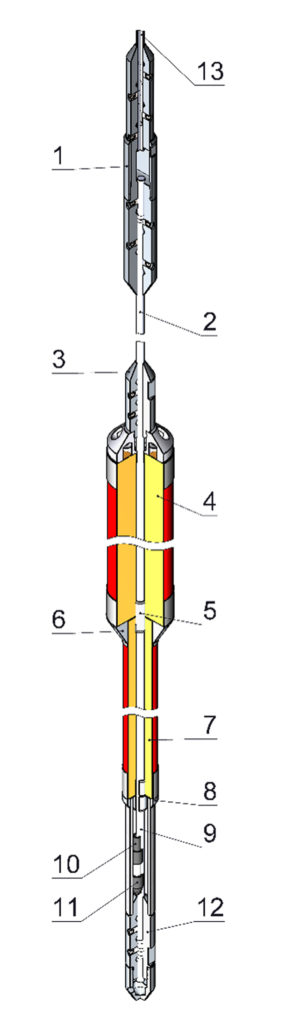
- Assembled head
- Carrier
- Assembled clamp
- Main charge
- Centralizing sleeve
- Middle centralizer
- Active charge
- Lower centralizer
- Detonating cord
- Cap
- Cartridge
- Assembled tip
- Geophysical cable
| Outer diameter, mm | From 40 to 105 |
| Maximum temperature, °C | 200 |
| Maximum allowable hydrostatic pressure for application, MPa | 80 |
| Explosive weight, g | From 0.9 to 7.1 |
Advantages:
- Ability to obtain data on the potential of productive formations in wells of various purposes;
- Ability to achieve significant increase in well productivity with minimal financial and time expenditures;
- Minimal risk of formation damage (skin zone contamination);
- The generator’s design eliminates both the shaped charge and brisant effects;
- Efficiency and mobility: operations are carried out by a single geophysical crew without the need for heavy specialized equipment.
- two charge combustion modes: volumetric and layer-by-layer;
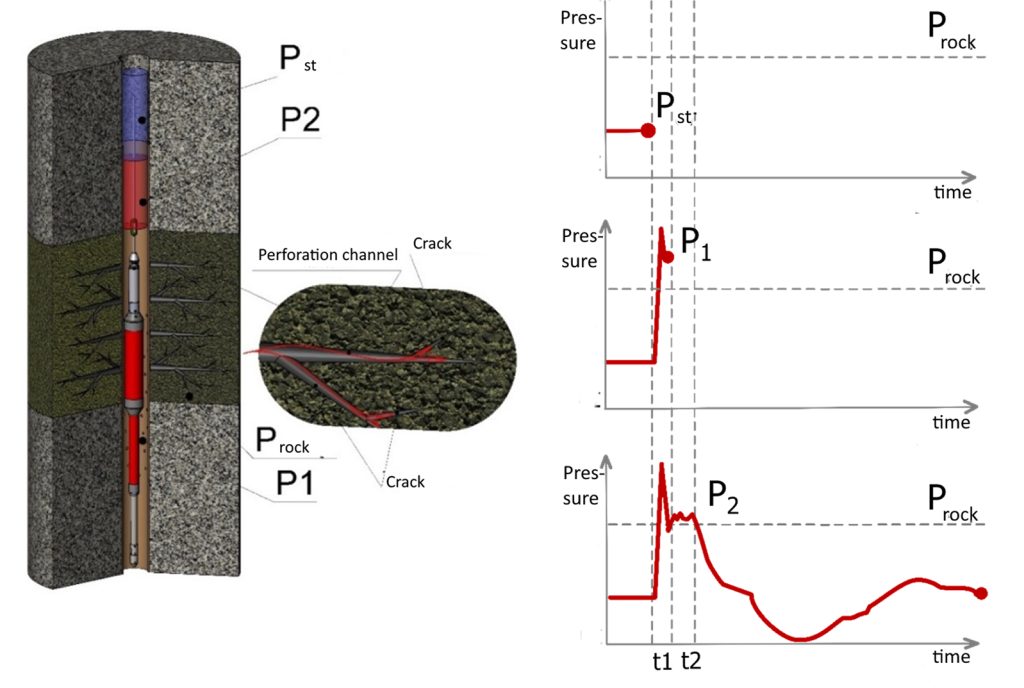
- simultaneous application of quasi-static and dynamic loads enhances the wedging effect of the fluid and gaseous combustion products;
- the use of different charge sizes and quantities allows for control over the intensity and duration of the impact;
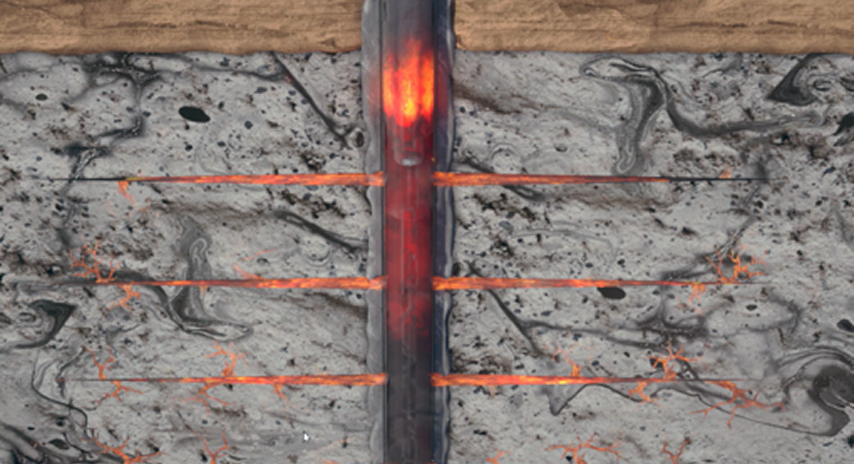
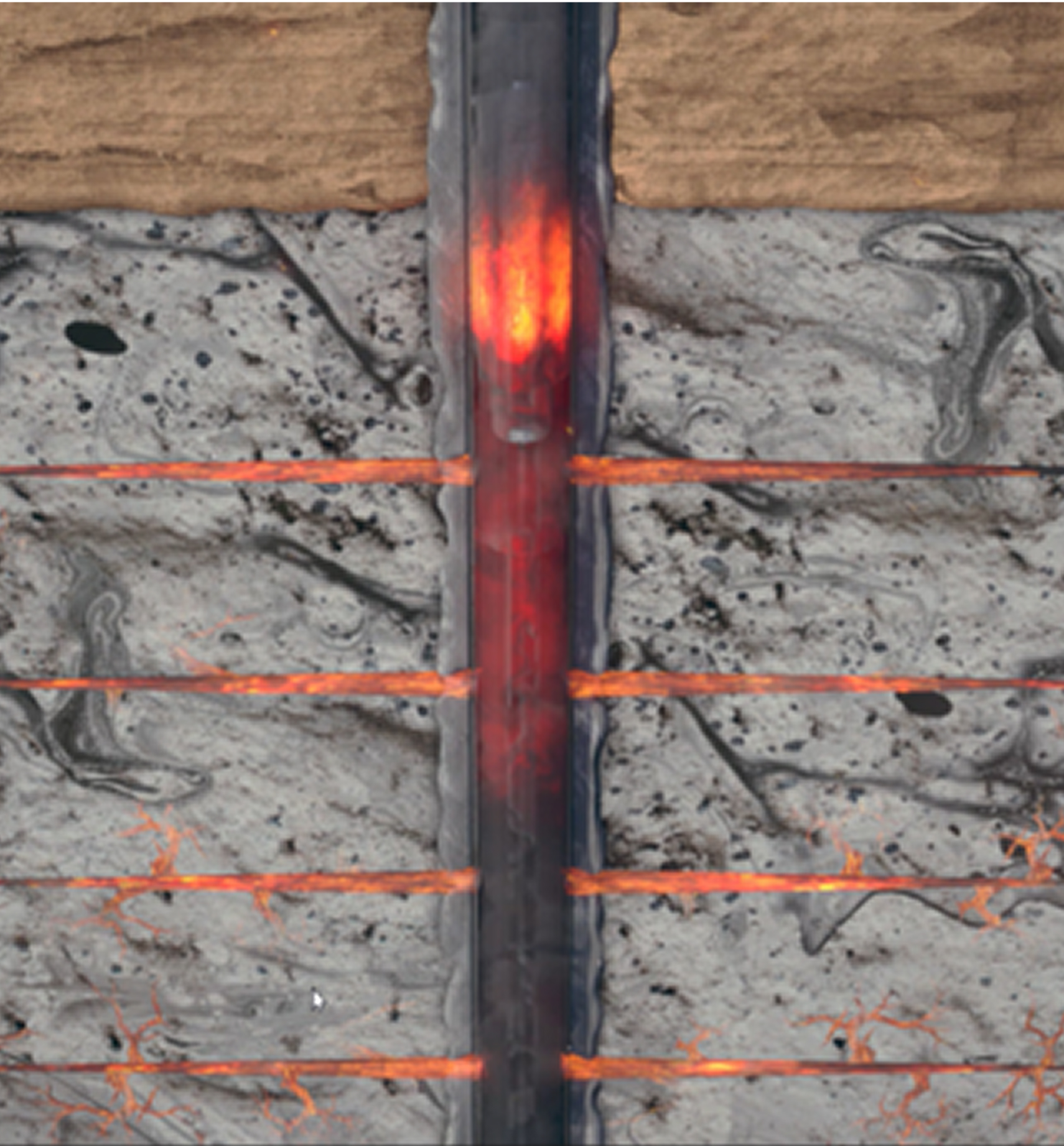
- mechanical, thermobaric, and chemical impacts on the formation create a branched system of residual fractures;
- repeated impact allows for increasing fracture length up to 10–15 meters and provides control over the formation fracturing process.
Legend:
P₍rock₎ – Formation (rock) pressure
P₁ – Pressure generated by the gas bubble during ignition charge combustion
P₂ – Pressure generated by the gas bubble during main charge combustion
P₍st₎ – Hydrostatic pressure
